


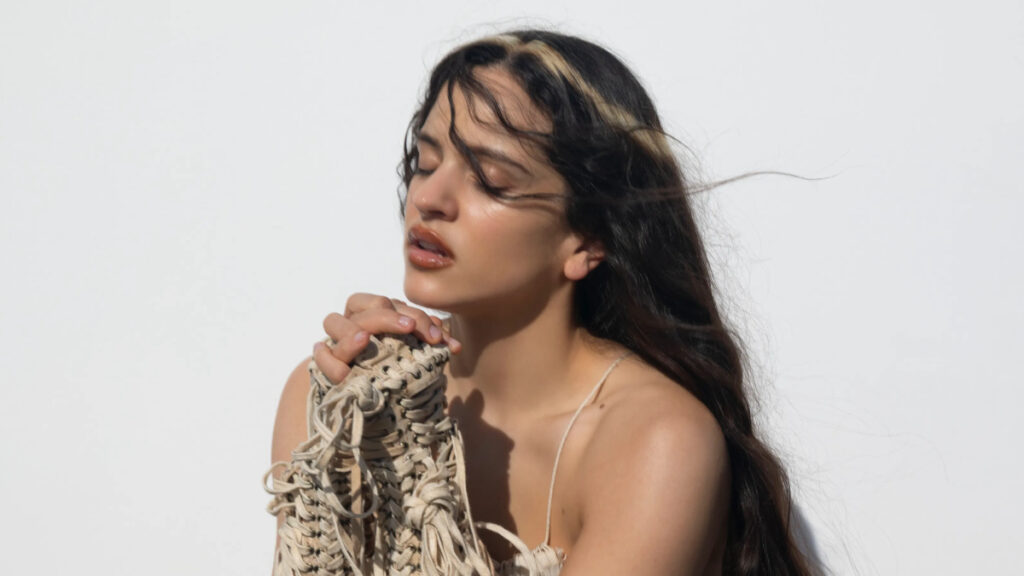
I listen to Rosalía’s album Lux as rain sweeps across the garden. It feels like nightfall, though it is only midafternoon, and the daylight keeps trying to press through the clouds. If Motomami radiated a kind of dark brilliance, Lux speaks of a longing to glimpse a new land. The question of meaning threads through the debates of our age. Within it lies what we might call the “theological turn”—to borrow a term dear to French phenomenology—at the heart of a culture beginning to recognize itself as postsecular.
If the two greatest living American writers—Christian Wiman and Marilynne Robinson—have confronted faith from within doubt, and if Jon Fosse has renewed the mysterious generativity of the Gospels, Rosalía’s latest work joins a similar search for the absolute. Its release urges us to go beyond the narrow confines of pop music and face a radical question: whether we can save ourselves or whether redemption comes from elsewhere. This question has hovered over religious experience for centuries. It is the “immortal rumor,” as the German philosopher Robert Spaemann once called it. Lux can be heard as an expression of that same yearning for fullness.
Time and again, we are saved. Parents protect their children as they enter the world and grow into it. They are the ones who teach them to love and to discover the richness of language. Friends walk beside us along the unsteady paths of life. And mature love reveals that the center of intimacy is never the self. No one is the light of their own existence.
We are redeemed by love’s generosity. This is no trivial conviction, and it must be followed to its final consequences. What happens when we confront meaninglessness? What happens when one person refuses to treat another as a neighbor, condemning them to the hell of ingratitude? What happens, in the end, when nothingness seeks the last word?
Rosalía approaches these questions through the great figures of feminine spirituality. From Saint Olga of Kyiv to Ry?nen Gens?, from R?bi?a al-?Adawiyya to Saint Clare of Assisi, the references scattered throughout Lux testify to a desire not easily satisfied. Among them, the presence of Simone Weil forms a bridge to our own time: a mystic without a Church who pushed the question of God’s love to its limits. In 1938, shortly after leaving Spain and escaping the horrors of the Civil War, Weil wrote of finding, at the Benedictine abbey of Solesmes, “a pure and perfect inner joy in the unheard-of beauty of the chant and the words.” Jewish by birth and agnostic in her youth, she fell in love with Christ so completely that she let herself starve in solidarity with the victims of the Holocaust. Weil taught that to love is to empty the self so that the Other may save us. Her writings still strike a deep chord.
In her conversation with Zane Lowe for Apple Music, Rosalía said that one can sing only from the deepest truth, and that a few years ago she would not have been able to make this album. Her authenticity was the same; the light was not. That this search should unfold within the very temple of narcissism makes it all the more striking. Not every song reaches the purity of its aim, but even in their imperfections, something noble breathes.
Can love save us from nothingness? The mystics of Lux pose the question in their own way. Rosalía lets the question shine.
This essay was originally published in Spanish in The Objective on Tuesday, November 11.